In our previous articles, we explored what agentic AI is and the infrastructure needed to deploy it reliably.
We talked about the 80/20 reality (agents handling routine work while humans focus on complex decisions) and the gradual progression from human-in-the-loop to confident autonomy.
Now let’s tackle a question that comes up constantly:
“Should we build one capable AI agent, or multiple specialised agents working together?”
The answer matters more than you might think.
While a single agent can be powerful, there’s a limit to how much you can ask one system to handle effectively.
Just like you wouldn’t hire one person to be your accountant, developer, designer, and customer service rep all at once, AI agents work better when they’re specialised.
This is where multi-agent systems come in. And we’re not talking about science fiction; companies are using these systems today to handle complex workflows that single agents can’t manage well.
The site visit coordination challenge
Let’s start with a real-world example. Your organisation needs to coordinate site visits with people travelling to work locations. This involves:
- Checking if the person is available (rostering)
- Booking accommodation near the site
- Arranging flights that align with the schedule
In a traditional setup, this might involve three different people or teams, each checking their systems, making bookings, and coordinating with the others. It’s time-consuming, prone to delays, and frustrating when availability doesn’t align.
Could you build one super-smart AI agent to handle all of this?
Technically, yes. But here’s what happens in practice when you ask a single agent to do everything:
It becomes a generalist rather than a specialist. The agent knows a bit about rostering, accommodation, and flights, but isn’t particularly good at optimising any of them. A specialist roster agent would deeply understand shift patterns, coverage requirements, and compliance rules. A generalist agent treats it as just another task.
The instructions become unwieldy. To handle all these scenarios, you need extensive prompts covering every possible situation across three domains. This makes the agent slower, more expensive to run, and harder to maintain.
Changes break everything. Need to update your accommodation booking process? You have to carefully modify the giant prompt and test that you didn’t accidentally affect how roster changes or flight bookings work. One change can have unexpected consequences.
You can’t optimise for different needs. Rostering might need deep integration with your HR system and compliance rules. Accommodation needs price and location data. Flight booking needs real-time availability and your travel policy. A single agent can’t be optimised for all of these at once.
How multi-agent systems actually work
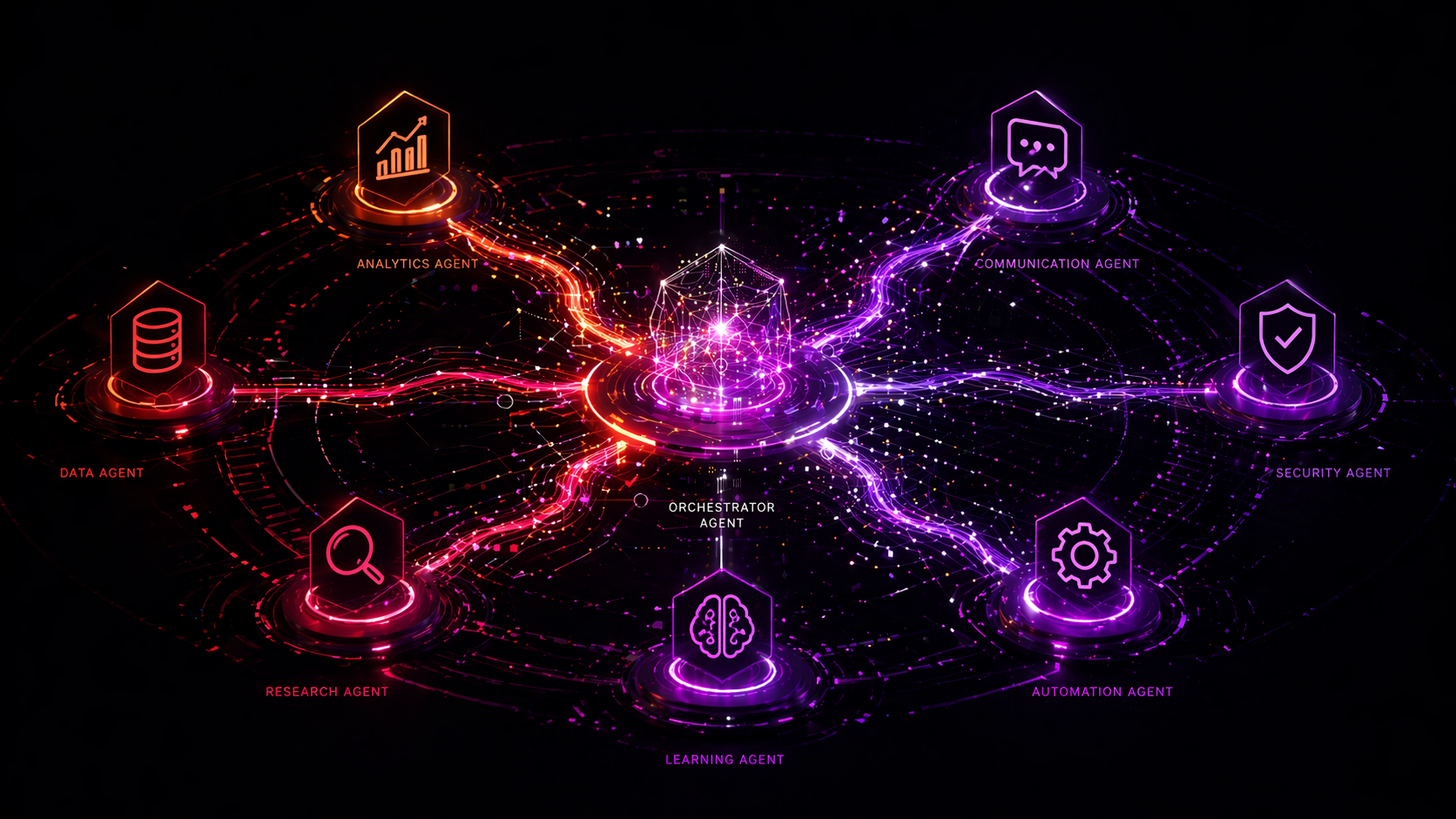
Instead of one generalist, you build a team of specialists. Each agent has a specific role, access to the tools it needs, and deep expertise in its domain. They work together, coordinated by a system that routes tasks to the right specialist.
For site visit coordination:
Coordinator Agent: When a site visit request comes in, this agent understands what needs to happen and orchestrates the other specialists. It’s the team’s project manager.
Roster Agent: Checks current schedules, identifies whether the person can be freed up for the dates needed, understands coverage requirements, and updates the roster if approved. It’s connected to your HR system and knows all the rostering rules.
Accommodation Agent: Searches for accommodation near the site, compares options based on company policy and budget, checks availability for the required dates, and makes bookings. It has access to booking systems and understands your travel policies.
Flight Agent: Finds appropriate flights within budget, checks seat availability, considers travel time and connections, and makes reservations. It’s integrated with flight booking systems and your corporate travel account.
When everything aligns (the roster allows it, there’s accommodation available, and there are seats on the flight) the agents handle it all automatically. The person making the request gets confirmation, and they’re all set.
But here’s where it gets interesting: what happens when there’s a problem?
Handling the edge cases
Let’s say all the flights are fully booked. The flight agent can’t just bump someone off the plane or charter a private jet without approval. It doesn’t have the context to know whether this particular site visit is more urgent than other passengers’ travel plans.
This is exactly the kind of edge case that falls into the 20% requiring human judgment. The agent system recognises it can’t complete the task autonomously and escalates to a human who can make the call. Maybe they:
- Approve chartering a different flight if it’s urgent
- Reschedule the site visit for when flights are available
- Prioritise this travel over someone else’s trip
- Find an alternative solution that the agents didn’t consider
The agents handle 80% of cases where everything aligns smoothly. Humans handle the 20% that need context, judgment, and authority.
When you actually need multi-agent systems
Let’s be practical. Multi-agent systems add complexity. They’re not always the right answer. Here’s when they make sense:
Your workflows naturally involve different specialisations
If your process requires distinctly different types of expertise, separate agents make sense. Other examples beyond site visits:
Customer service workflow:
- The routing agent directs enquiries to the right specialist
- Product specialist handles feature questions and recommendations
- A technical support agent troubleshoots issues
- The billing agent manages payment and subscription questions
- Returns agent processes refunds and exchanges
Software development workflow:
- The requirements analyst agent clarifies what needs to be built
- The code generation agent writes the implementation
- The testing agent creates and runs test cases
- Documentation agent updates technical docs
- The deployment agent handles the release process
Data analysis workflow:
- A collection agent gathers data from various sources
- Cleaning agent standardises and validates data
- The analysis agent runs calculations and identifies patterns
- The visualisation agent creates charts and dashboards
- The reporting agent summarises findings for stakeholders
You need different security levels for different tasks
Maybe one agent needs read-only access to customer data, while another needs to process payments. Separate agents let you implement proper least-privilege access control. Each agent has permissions for what it actually needs to do.
In the site visit example, the roster agent needs to modify schedules in your HR system. The accommodation agent needs to make bookings and enter credit card information. The flight agent needs access to your corporate travel account. Keeping these as separate agents means each has only the specific permissions it requires.
Your system needs to scale different parts independently
During busy periods, your customer service routing agent might need 10x capacity while your billing agent maintains normal levels. Separate agents let you scale precisely where you need it, controlling costs and performance.
With site visits, you might have seasonal patterns, busy periods when people travel, and quiet periods when travel is minimal. With separate agents, you can scale each one based on its actual demand rather than over-provisioning everything.
You want to improve specific capabilities without risk
With separate agents, you can upgrade your technical support agent’s capabilities without touching your billing agent. You can test changes in isolation, measure impact clearly, and roll back if something goes wrong.
If you want to improve how the accommodation agent finds and compares options, you can work on that agent specifically without any risk to rostering or flights.
Different agents serve different purposes
Sometimes you need variety in how agents operate:
Speed requirements vary: Your order status checker needs to respond in seconds. Your market research agent might take several minutes to compile a thorough report. Separate agents let you optimise each for its specific time requirements.
Confidence thresholds differ: Maybe your roster agent can operate autonomously at 85% confidence (routine shift changes), but your flight agent requires 95% confidence before booking without approval (cost and complexity).
Human review varies: Perhaps accommodation bookings always happen autonomously within budget, but flight bookings over a certain cost need approval regardless of confidence.
When one agent is enough
On the flip side, you might not need multiple agents if:
Your use case is focused: A single, well-defined task like “analyse customer feedback and create weekly summaries” doesn’t need multiple agents. One agent with good prompting can handle it.
Handoffs add more complexity than value: If your workflow is mostly linear without much need for different specialisations, the overhead of coordination might not be worth it.
You’re just getting started: It’s often smarter to begin with one agent, understand the problems deeply, and split into specialists only when you have clear evidence that it’s needed.
Start simple. Add complexity only when the benefits clearly outweigh the costs.
The orchestration challenge
Here’s the tricky part about multi-agent systems: someone has to manage the managers.
In the site visit example, the coordinator agent needs to:
- Understand the incoming request well enough to know what needs to happen
- Know which specialist agents are available and what they can do
- Coordinate the sequence—check roster availability before booking flights
- Handle handoffs smoothly when one agent completes, and another needs to start
- Manage state so information flows correctly between agents
- Deal with failures gracefully when a specialist can’t complete their task
- Make decisions about when to escalate to humans
- Provide clear status updates to the person who made the request
This orchestration layer is critical. If your coordinator sends tasks to the wrong specialist or loses context during handoffs, you’ve made the experience worse than a single agent would have been.
Getting orchestration right requires:
Clear definitions: Each agent needs well-defined capabilities and boundaries. The coordinator must understand what each specialist can and can’t do.
Communication protocols: Agents need standard ways to pass information between each other without losing important context.
State management: The system needs to track what’s been completed, what’s in progress, and what’s waiting—especially when processes span time (like waiting for flight availability).
Fallback strategies: When a specialist is unavailable or fails, what happens? Does another agent take over? Does the system queue the request? Does it escalate to humans?
Monitoring and improvement: You need visibility into how coordination is working so you can identify bottlenecks, routing mistakes, or handoff problems and improve over time.
Building confidence across multiple agents
Remember the progression we discussed in article one, starting with human-in-the-loop and gradually moving to autonomous operation based on confidence scores?
With multi-agent systems, this gets more nuanced because different agents might progress at different rates.
Example progression for site visits:
Months 1-2: All human-reviewed
All three agents (roster, accommodation, flight) propose actions, but humans review every decision before anything happens. You’re building confidence and finding edge cases.
Month 3-4: Roster agent autonomous at 90%+ confidence
The roster agent handles straightforward schedule changes automatically when highly confident. Accommodation and flight agents still need approval for all bookings.
Months 5-6: Accommodation is autonomous for budget bookings
An accommodation agent can book autonomously when options are clearly within policy and budget. Roster agent continues improving. The flight agent still requires approval.
Month 7+: System-wide autonomy for routine cases
All three agents handle 80% of routine cases autonomously. The 20% that involve edge cases, high costs, or unusual circumstances still get escalated to humans.
Different agents reach autonomy at different times based on their complexity and your confidence in their decisions. That’s normal.
Infrastructure support for multi-agent systems
This is where the infrastructure we discussed in article two becomes crucial.
AgentCore Identity: Each agent gets its own identity with specific permissions. The roster agent can modify schedules, the accommodation agent can make bookings, the flight agent can access travel systems—but none can access what they don’t need.
AgentCore Runtime: The coordination between agents happens reliably, with state maintained across the workflow. If the roster agent completes and the accommodation agent needs to start, the context transfers correctly.
AgentCore Gateway: Each agent’s tools are integrated through a consistent interface. Adding a new accommodation booking service or changing flight providers doesn’t require rebuilding the whole system.
AgentCore Observability: You can trace the complete flow across all agents. When something goes wrong, you can see exactly where. Was it the coordinator’s routing decision, the roster check, the accommodation search, or the flight booking?
Without proper infrastructure, building reliable multi-agent systems is extremely difficult. With the right platform, it becomes manageable.
Starting with multi-agent systems
If you’re thinking about moving from single agents to multi-agent systems, here’s a practical approach:
- Map your workflows
Draw out how work actually flows through your organisation today. Where are the handoffs? What specialised knowledge does each step require? Where are the bottlenecks?
- Identify natural boundaries
Look for places where the work clearly separates into distinct specialisations. These are your candidate agents. In site visits, the natural split is roster/accommodation/flights.
- Start with one split
Don’t try to build your entire multi-agent system at once. Take your most obvious separation and implement two agents with a clear handoff between them. Learn from that before expanding.
- Design handoffs carefully
The connections between agents matter as much as the agents themselves. How will context transfer? What happens if one agent fails? How do you maintain state during the workflow?
- Build observability first
Make sure you can see what’s happening across the agent team. This is essential for debugging, building confidence, and improving over time.
- Monitor the seams
Watch where agents connect. That’s where problems will emerge first. Make sure you have visibility into handoffs, routing decisions, and state management.
- Scale gradually
As you prove out one successful agent pair, you can add more specialists and build up your orchestration capabilities over time.
Real-world patterns we see
From working with clients implementing multi-agent systems, here are patterns that consistently work well:
Pattern 1: Router + Specialists
One routing agent that understands incoming requests and directs them to specialised agents. Works great for customer service, support tickets, or any workflow with multiple possible paths.
Pattern 2: Sequential specialists
Agents work in a defined sequence, each doing their part before passing to the next. Good for manufacturing processes, content creation workflows, or approval chains.
Pattern 3: Parallel specialists + Aggregator
Multiple agents work simultaneously on different aspects, and then an aggregator combines their results. Useful for research tasks, data analysis, or due diligence processes.
Pattern 4: Coordinator + Specialists
A coordinator orchestrates multiple specialists who might work sequentially or in parallel. The site visit example follows this pattern.
Choose the pattern that matches your workflow’s natural structure.
What this means for your business
Multi-agent systems aren’t just a technical architecture choice. They represent a different way of thinking about how work gets done.
Instead of asking “How can one AI agent help with this process?” you’re asking “How can we design a team of specialised agents working together to achieve better outcomes?”
That’s a bigger question. It requires understanding your workflows, identifying where specialisation adds value, and designing for reliable coordination.
But for organisations willing to do that work, the results can be transformative. Not just incremental efficiency gains, but fundamental improvements in how work flows through your organisation.
The key is starting with clear, focused use cases where the value of specialisation is obvious, like site visit coordination, customer service routing, or approval workflows and building from there.
Curious about whether multi-agent systems make sense for your workflows?
Let’s talk about your specific use cases and what approach would work best.